 In the world of Computer-Aided Manufacturing (CAM), the bridge between a digital design and a finished physical part is the simulation. It is the critical "sanity check" that ensures your toolpaths are accurate, your stock is being removed correctly, and—most importantly—that you aren't about to crash an expensive spindle into a workpiece.
Contents
The Evolution of Simulation Methods
The Power of the GPU: Why NVIDIA Matters
Performance Benchmarks: Speeding Up the Workflow
2-Axis Machining (Mass Production 2x Faster!)
3-Axis Two-Sided Machining (5x Faster!)
4-Axis Indexed Machining (7x Faster!)
5-Axis Indexed Machining (6.5x Faster!)
Conclusion: A New Standard for CAM
Introduction
For years, CNC programmers have faced a frustrating trade-off: speed versus accuracy. You could have a lightning-fast "Voxel" simulation that lacked detail, or a high-precision "polygonal" simulation that could take several minutes (or even hours) to calculate complex toolpaths.
MecSoft Corporation is changing that equation. In our recent webinar, we deep-dived into the groundbreaking NVIDIA GPU-Accelerated TriDexel Simulation arriving in the 2026 version of RhinoCAM. Here is a comprehensive look at how this technology works and why it represents a massive leap forward for the industry.
The Evolution of Simulation Methods
To understand why TriDexel is a game-changer, we first have to look at the existing methods used in RhinoCAM and :
•The Box (Voxel) Method: Think of this as a low-resolution approach. It uses "voxels" (volumetric pixels), essentially tiny cubes, to represent the stock. While fast, it is often direction-dependent, meaning it cannot simulate undercuts or multi-sided setups.
•The Polygonal Method: This is currently the gold standard for accuracy. It calculates actual facets on the model to represent the tool and the cut stock. While highly precise for 3, 4, and 5-axis work, it is computationally heavy. As your toolpath complexity accuracy requirements grow, the simulation time increases significantly because there are more polygons to calculate.
What is TriDexel?
The new TriDexel simulation is a hybrid approach that offers the best of both worlds.
In technical terms, while a voxel is a simple cube, a Dexel is a "depth element"—a ray that calculates depth along an axis. TriDexel takes this further by calculating these rays along all three axes (X, Y, and Z) simultaneously.
The software then "stitches" these three-directional calculations together to form a high-quality polygonal model for display. This provides a representation that is nearly identical to the high-end polygonal method but at a fraction of the time.
The Power of the GPU: Why NVIDIA Matters
The "secret sauce" behind TriDexel’s speed is Hardware Acceleration. Traditional simulations rely on your computer’s CPU (Central Processing Unit). While CPUs are great for general tasks, they aren't optimized for the massive parallel math required for 3D simulation.
The TriDexel engine offloads these calculations to the NVIDIA GPU (Graphics Processing Unit). By utilizing the dedicated processors and high-speed RAM on an NVIDIA graphics card, the software can perform thousands of calculations simultaneously.
Key Hardware Takeaways
•Requirement: You must have an NVIDIA graphics card to enable this feature.
•Scalability: The performance scales with your hardware. While the time-trial results shown below demonstrate significant gains on an "off-the-shelf" 12GB NVIDIA graphics card, using a high-end NVIDIA card with more memory can lead to "near-instant" simulations.
Performance Benchmarks: Speeding Up the Workflow
Don’t just take our word for it. The most impressive evidence is the side-by-side time trials mentioned below. Across every category of machining, 2½-Axis, 3-Axis, 4-Axis and 5-Axis, the TriDexel method consistently outperformed the traditional polygonal method by massive margins. Continue reading to see the results!
2-Axis Machining (Mass Production 2x Faster!)
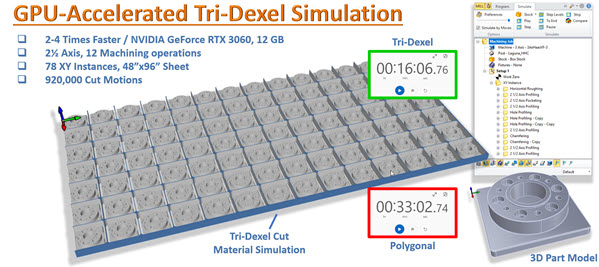
In a test case featuring a 4x8 sheet with 98 parts, the TriDexel method cut simulation time in half. Interestingly, if the operations were programmed collectively rather than XY Instances, the speed increase could jump to 5 or 10 times faster. You can refer to the illustration below.
•Machining Job: 98 XY Instanced Parts, 12 Operations, 920,000 Cut Motions.
•Polygonal Simulation: 33 minutes
•TriDexel Simulation: 16 minutes
•Result: Over 2 Times Faster!
3-Axis Two-Sided Machining (5x Faster!)
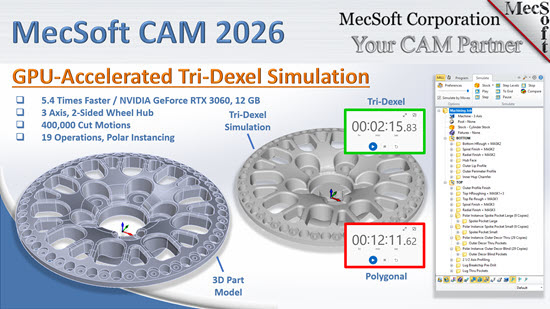
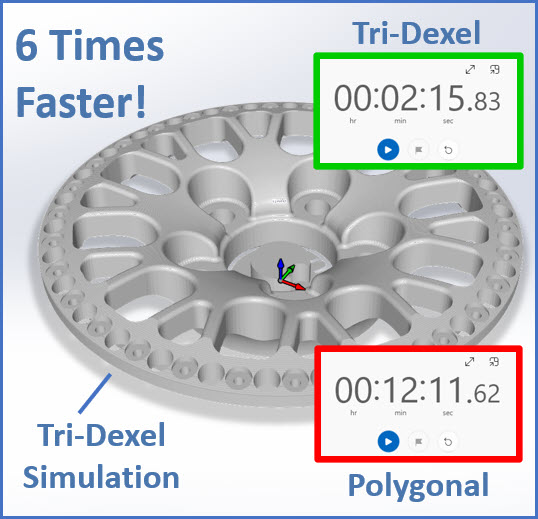
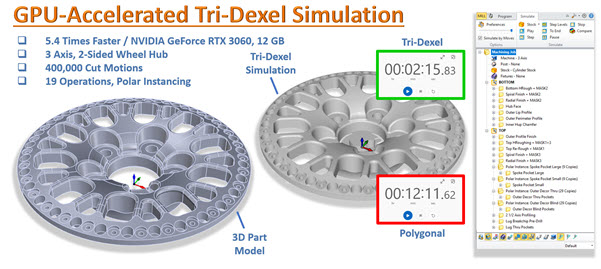
For a complex wheel hub requiring machining from 2 sides (400,000 cut motions across 19 operations), the results were staggering:
•Machining Job: Multi-sided Setups, 19 Operations, 64 Polar Instances, 400,000 Cut Motions
•Polygonal Simulation: 12 minutes
•TriDexel Simulation: 2 minutes
•Result: Over 5 Times Faster!
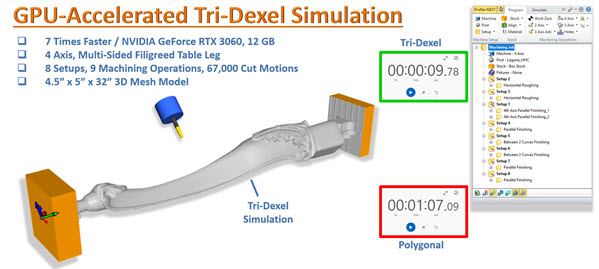
4-Axis Indexed Machining (7x Faster!)
Using a decorative chair leg with intricate "filigree" mesh details (67,000 cut motions across 8 Setups and 9 machining operations), the TriDexel model proved its worth for artistic and complex geometry:
•Machining Job: 8 Indexed 4 Axis Setups, 9 Operations, 67,000 Cut Motions
•Polygonal Simulation: 1+ minute
•TriDexel Simulation: 10 seconds
•Result: 7 Times Faster!
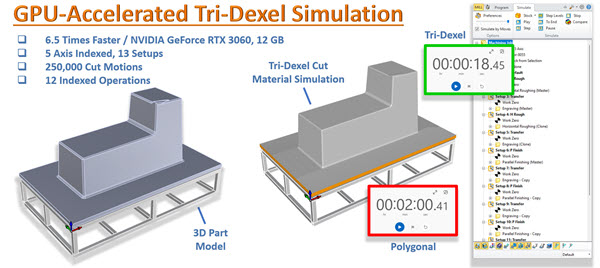
5-Axis Indexed Machining (6.5x Faster!)
In a high-complexity 5-axis test with 13 separate setups and 250,000 cut motions, the TriDexel simulation again left us waiting for the Polygonal simulation method to complete!
•Machining Job: 13 Indexed 5 Axis Setups, 12 Operations, 250,000 Cut Motions
•Polygonal Simulation: 2 minutes
•TriDexel Simulation: 18 seconds
•Result: 6.5 Times Faster!
The Complexity Paradox
One of the most unique benefits of TriDexel simulation is how it handles complexity. In traditional polygonal simulations, the more complex your toolpath becomes, the more the system slows down.
With TriDexel, the performance increase actually magnifies as the model gets more complex. This means that for your most difficult, high-detail jobs—the ones where you usually dread waiting for a simulation—the TriDexel method provides its greatest advantage. It is essentially exponentially faster than previous methods when you need it most!
Accuracy and User Control
A common concern with "faster" simulations is a loss of detail. However, our TriDexel simulation allows users to adjust the accuracy.
•If you need a quick "rough-in" check, you can loosen the accuracy for lightning speed.
•If you need to check for fine surface finish or tight tolerances, you can tighten the resolution to get a result that is visually indistinguishable from a full polygonal simulation.
Because TriDexel is direction-independent, it handles undercuts and multi-sided setups with ease, solving the primary limitation of the older box/voxel method.
Conclusion: A New Standard for CAM
The introduction of NVIDIA GPU-Accelerated TriDexel Simulation represents a fundamental shift in the CAM workflow. By reducing simulation times from twelve minutes down to two, or from minutes down to seconds, MecSoft is giving time back to the programmers.
No longer do you have to choose between a "fast but messy" simulation or an "accurate but slow" one. With the right NVIDIA hardware and the 2026 release of RhinoCAM, you can have high-fidelity, multi-axis simulations in near real-time.
The TriDexel Simulation module is available in the following RhinoCAM configurations. Contact support or our sales team at 949-654-8163 to upgrade:
•3+2 module
•Advanced 3-axis module
•EXPERT configuration
•PROFESSIONAL configuration
•PREMIUM configuration
Watch the Demonstration Here
Ready to see it in action? You can watch the full webinar and time-trial comparisons here: