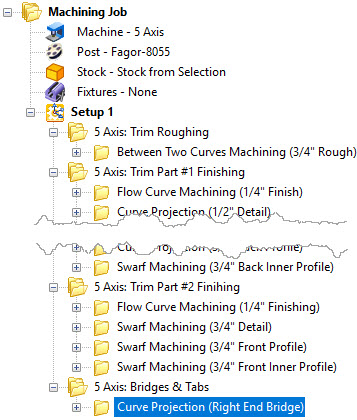
In this real-world example on a DMS 5 Axis machining center at the SITO Studio in the Brooklyn Navy Yard, the operation is a 5 Axis Curve Projection method that is located within the third MOpSet shown in the Machining Job below named 5 Axis Bridges & Tabs. It is so named because the 3/4” diameter CARBIDE flat end mill will cut the ends of Trim Part #1 and Trim Part #2 but will not cut the full depth of the part leaving 1/4” of stock material that will be removed manually after the parts are separated from the fixture. In the machining Job tree below you will see that it is selected under the 5 Axis Bridges & Tabs MOpSet.
The toolpath is calculated from a curve that is projected onto another surface. The Surface to Project To is an independent Drive Surface that extends outward from the ends of both parts. Refer to the illustration below. The Curve To Project lies ¼” above the bottom of both parts and is the edge of the Surface to Project To that extends outward from the ends of the part. The Normal Vector direction of the Surface to Project To orients the cutter axis. Cut Parameters include a Tolerance of 0.001”, Cut Pattern is Along the Curve Direction, the Cut Side is Left. The Total Cut Depth is 2.25” and the Depth per Cut is 0.125”. This creates a total of 9 cut levels each 0.125” in depth. Gouge Checking is performed against Trim Part #1 and Trim Part #2.
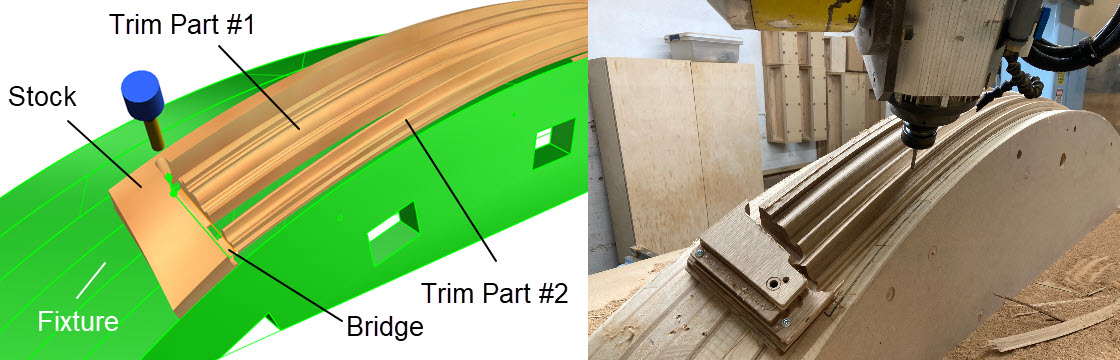
Above on the left we see the cut material simulation with the Bridge identified. The fixture is in green and the stock is textured wood. Trim Part #1 and Trim Part #2 are also identified. Above on the right we see a "proof of concept" prototype being cut on a DMS 5 Axis machining center at the SITO Studio in the Brooklyn Navy Yard.
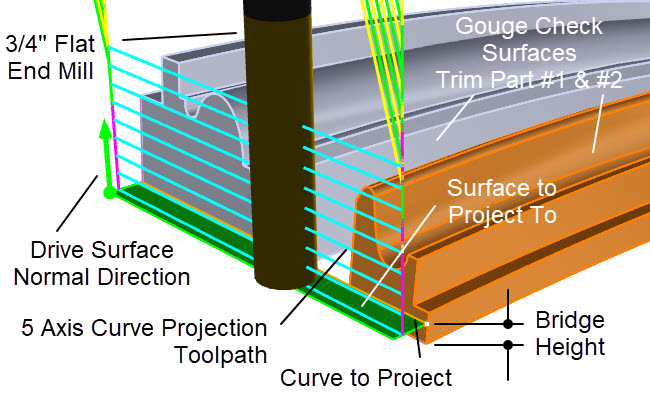
This is the final finishing pass for Trim Part #1 using a 3/4” diameter CARBIDE flat end mill leaving zero stock material from the side of the cutter but leaving 1/4” of stock material under the cutter to serve as a Bridge that will be removed manually after the parts are separated from the fixture. Refer to the full description above.